Natural Language vs. Tag Stacking: How AI Prompting Evolved
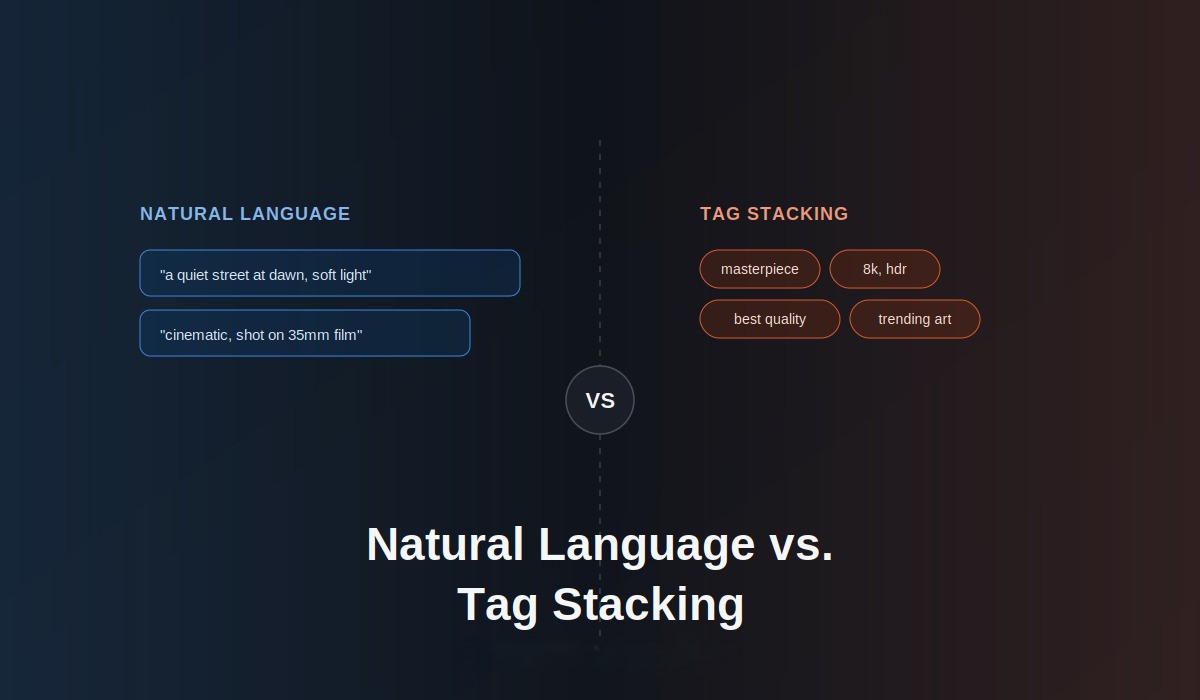
If you learned prompting on Stable Diffusion 1.5 and then opened Flux or Midjourney v6 for the first time, you probably noticed something strange: your old prompts just don't hit the same way anymore. That comma-separated wall of tags you used to swear by “1girl, masterpiece, best quality, forest, dappled light, cinematic, 8k” now produces images that feel flat, generic, or oddly literal.
You didn't get worse at prompting. The models changed underneath you.
This is the story of two prompting philosophies - tag stacking vs natural language, and why the entire ecosystem is quietly shifting from one to the other. Understanding this shift isn't just trivia; it directly affects how you should be writing prompts today.
The Era of Tag Stacking
To understand where we are, we have to look at where we started. When models like Stable Diffusion 1.5 (SD 1.5) burst onto the scene, they relied on an architecture that processed text using an encoder called CLIP.
While CLIP was revolutionary, it had a very specific way of reading text. It didn't truly understand grammar, sentence structure, or the relationship between words. If you typed, "A dog sitting next to a cat," CLIP might just see the concepts "dog", “sitting” and "cat" and jumble them together.
Because the AI lacked grammatical comprehension, users quickly discovered that treating the prompt box like a search engine yielded the best results. This gave birth to Tag Stacking style of prompting.
What Is Tag Stacking, Really?
Tag stacking is the practice of building a prompt using a list of comma-separated keywords or phrases, ordered by priority. Instead of writing a descriptive paragraph, you throw a barrage of highly specific descriptors at the AI.
Here is what a classic tag-stacked prompt looks like:
1girl, solo, cyberpunk city background, neon lights, glowing blue eyes, black leather jacket, wet streets, (masterpiece, best quality, ultra-detailed:1.2), 8k resolution, cinematic lighting, sharp focus
No grammar. No sentences. Just nouns, adjectives, and "quality boosters" stacked one after another, sometimes with parentheses and colons for emphasis.
This style wasn't just a stylistic choice, it was a direct reflection of how early text-to-image models actually read prompts.
Why Tag Stacking Works on Older Models
Models like Stable Diffusion 1.5 and early SDXL checkpoints used CLIP as their text encoder. CLIP was originally trained to match images with short captions scraped from the internet like alt-text, image board tags, and photo captions, not flowing prose.
CLIP has a hard token limit (typically 75 tokens per chunk) and, more importantly, it doesn't understand grammar or sentence structure the way a language model does. It's essentially matching a bag of concepts to a bag of visual features. Feed it a full sentence with clauses and conjunctions, and a lot of that structure gets ignored, it collapses back into keyword matching anyway.
So the community adapted. If the model behaves like it's just averaging keywords, prompt it like that, just with keywords. Tag stacking wasn't a hack, it was the correct strategy for a CLIP-based brain. Community-trained checkpoints (many based on Danbooru-tagged anime datasets) reinforced this even further, since those images were tagged in exactly this comma-separated style during training.
The Paradigm Shift: Enter Natural Language
As AI researchers realized the limitations of CLIP, they began integrating massive, highly advanced language models similar to the technology powering ChatGPT directly into their image generators.
Models like Stable Diffusion 3, FLUX, Z-image, Krea2, utilize advanced text encoders like T5-XXL , Qwen VL. These new brains do not just read words; they understand syntax, spatial relationships, and context. These encoders were trained to understand language, not just match keywords.
This technological leap birthed Natural Language Prompting. The model's ability to parse relationships determines whether tags or sentences work better. Better language understanding = better payoff from writing in actual language.
What is Natural Language Prompting?
Natural language prompting flips the format entirely. Instead of a tag list, you write a real sentence or short paragraph describing the scene, the way you'd describe it to a photographer or illustrator. You speak to the AI as if you are describing a scene to a human artist or a movie director.
Here is how you would write the cyberpunk scene from earlier using natural language:
A cinematic, eye-level photograph of a young woman standing alone in a futuristic cyberpunk city. She is wearing a distressed black leather jacket and looking directly into the camera with intensely glowing blue eyes. The background features towering skyscrapers covered in vibrant neon signs. The streets below her are wet and reflective from a recent rain, catching the colorful neon glow. Shot on 35mm film with a shallow depth of field.
The Magic of Natural Language
When you use natural language with a modern model like FLUX, you unlock capabilities that were impossible in the tag-stacking era:
- Spatial Awareness: You can tell the AI exactly where things belong. "A red apple resting on a wooden table, with a green vase positioned to the left of it in the background." FLUX understands "left," "right," "background," and "foreground."
- Attribute Binding: In the old days, if you asked for a "man in a red shirt and a woman in a blue dress," the AI would often mix them up and give you a man in a blue shirt. Natural language models excel at binding colors and traits to the correct subjects.
- No More "Magic Words": Modern models are trained to produce high-quality images by default. You no longer need to spam masterpiece or 4k. In fact, adding those words can sometimes confuse the AI and make the image look artificial.
- Text Rendering: Because models like FLUX actually understand language, you can ask them to generate readable text. You can simply write: She is holding a cardboard sign that says "PromptDexter is Awesome!" and the AI will spell it flawlessly.
Does This Mean Tags Are Dead?
While it might sound outdated, tag stacking is far from dead. It remains the absolute best way to communicate with specific families of AI models. If you are using Anime-focused models (like illustrious, Pony Diffusion), tag stacking is mandatory. These models were trained specifically on image datasets labeled with millions of individual tags (often scraped from imageboards like Danbooru). For these models, tag stacking is their native language.
A Side-by-Side Comparison
To truly grasp how these styles differ, let's look at how you handle common image generation challenges using both methods.
| Tag Stacking | Natural Language | |
|---|---|---|
| Best suited for | CLIP-only models (SD1.5, older SDXL checkpoints) | T5/LLM or QWEN VL based models (Flux, Z-Image, Krea2) |
| Structure | Comma-separated keywords | Full sentences, descriptive prose |
| Relationships between objects | Ambiguous, model guesses | Explicit through grammar |
| Negative Prompting | Negative prompts are a massive safety net. You paste a generic 50-word negative prompt into every generation | Negative prompts are rarely needed, models generate structurally sound images by defaul |
| Emphasis control | Parentheses/weights (word:1.2) | Descriptive intensity words ("intensely," "faint," "barely visible") |
| Great for | Style keywords, camera terms, quality boosters | Composition, mood, interacting subjects, storytelling scenes |
| Common failure mode | Attribute bleeding (wrong color/object pairing) | Overly long, vague, or contradictory sentences confuse the model |
| Learning curve | Easy to start, hard to master nuance | Harder to start, more intuitive once learned |
To Summarize
Tag stacking and natural language aren't rival techniques competing for the "correct" way to prompt, they're two languages shaped by two different generations of text encoders. Tag stacking made perfect sense when models like CLIP were essentially matching keyword soup to visual patterns. Natural language makes sense now that models are built on text encoders that genuinely parse grammar, relationships, and intent.
As image models keep absorbing more language-model DNA, expect this trend to keep moving in one direction: toward prompting the way you'd talk to a person, not the way you'd fill out a spreadsheet.
Neither style is inherently "wrong." The secret to becoming a master prompter in 2026 is flexibility. By understanding how the architecture beneath the AI reads your text, you can tailor your approach to the specific model you are using.
By mastering the language of the machine, the only limit to what you can create is your own imagination. Happy prompting!