How to Prompt for Weather, Time of Day & Atmospheric Effects
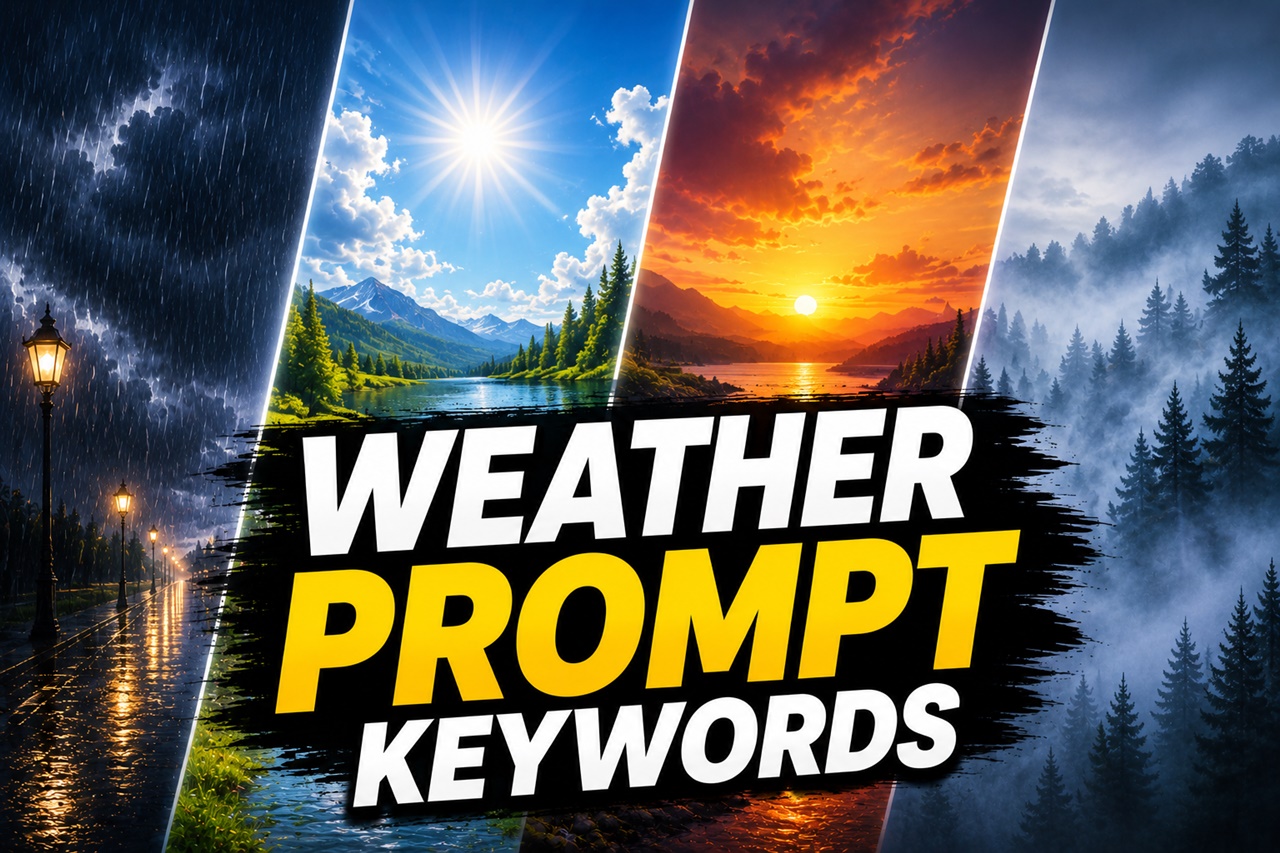
Two prompts. Same subject: "a lighthouse on a cliff." One image looks flat and generic, a lighthouse, some rocks, done. The other feels like a scene from a film, with mist rolling off the sea and the last orange light of dusk hitting the tower. The only difference? A handful of words describing weather, time of day, and atmosphere.
This is one of the fastest ways to level up any prompt without touching your subject description at all. In this guide, you'll learn the exact vocabulary and layering technique to turn flat, generic images into ones with real mood, depth, and cinematic quality, even if you're a complete beginner.
Why Weather, Time of Day, and Atmosphere Matter So Much
Most beginners spend all their effort describing the subject, the character, the object, the pose and completely skip the environment around it. But weather, time of day, and atmosphere do three things a subject description alone can't:
- They set the mood. A rainy alley feels tense or melancholic. The same alley in soft morning light feels calm and hopeful.
- They add depth and realism. Fog, haze, and light rays give the AI model spatial cues to work with, which often results in more three-dimensional, photographic-looking images.
- They control color and contrast automatically. Time of day words like "golden hour" or "blue hour" push the whole palette in a specific direction without you having to specify individual colors.
In short, this category of prompting is a shortcut to "cinematic" results.
The Building Blocks: Vocabulary for Weather Prompts
Weather is more than just "rainy" or "sunny." The strength of your prompt comes from specificity. Here's how to think about it in layers.
1. Name the weather type
Start simple and literal:
- Rain, drizzle, downpour, thunderstorm
- Snow, snowfall, blizzard, frost
- Fog, mist, haze
- Overcast, cloudy, clear sky
- Windy, storm clouds, heatwave
2. Add intensity and behavior
A single adjective changes everything. Compare "rain" vs. "light drizzle" vs. "heavy torrential rain." Try combining:
- Light / gentle / soft for subtlety
- Heavy / intense / torrential for drama
- Sudden / rolling in / approaching for a sense of motion or narrative
3. Add physical detail
This is where images start to feel real instead of illustrated:
- "raindrops on glass"
- "wet pavement reflecting neon lights"
- "snow settling on rooftops"
- "puddles reflecting streetlights"
- "mist clinging to the treeline"
Example prompt:
a woman walking through a city street, heavy rain, wet asphalt reflecting neon signs, raindrops streaking across a nearby window
Notice how this doesn't just say "rainy city", it describes what rain does to the surfaces in the scene. That's the difference between a beginner prompt and an advanced one.
Mastering Time of Day Language
Time of day is arguably the single highest-leverage phrase category in your entire prompt, because it controls lighting direction, color temperature, and shadow length all at once.
Here are the core phrases every prompter should know:
| Time of Day | Mood/Look | Prompt Phrase Examples |
|---|---|---|
| Early morning | Soft, cool, hopeful | "early morning light," "dawn," "soft morning haze" |
| Golden hour | Warm, cinematic, flattering | "golden hour," "warm sunset glow," "low angle sunlight" |
| Midday | Bright, high contrast, neutral | "harsh midday sun," "bright daylight," "overhead sunlight" |
| Blue hour | Cool, moody, cinematic | "blue hour," "dusk," "twilight glow" |
| Night | Dramatic, mysterious | "night scene," "moonlight," "neon-lit night," "starlit sky" |
A quick tip: "golden hour" and "blue hour" are two of the most reliable phrases in text-to-image prompting. They're borrowed straight from photography, so most models have seen thousands of tagged photos using these exact terms, meaning they respond very consistently.
Example prompt:
a mountain cabin at golden hour, warm sunlight filtering through pine trees, long shadows stretching across the grass
Compare that to the same scene at blue hour:
a mountain cabin at blue hour, cool blue-purple sky, a single warm light glowing from the window
Same subject, completely different feeling, just from the time-of-day phrase.
Atmospheric Effects: The Secret Ingredient for Depth
If weather and time of day set the scene, atmospheric effects are what make it feel like you can step into it. These are the phrases that create depth, layering, and that "cinematic" quality people struggle to name but instantly recognize.
Fog, mist, and haze
These effects soften distant objects and create natural depth layers. Great for moody, mysterious, or dreamy scenes.
- "light fog rolling across the field"
- "hazy atmosphere with soft depth"
- "morning mist between the trees"
Dust and smoke
Perfect for gritty, dramatic, or post-apocalyptic scenes.
- "dust particles floating in sunlight"
- "smoke drifting through the air"
- "sun rays cutting through dust"
Light rays and volumetric lighting
This is one of the most powerful phrases for adding a "wow factor" to any image.
- "volumetric lighting"
- "god rays through the clouds"
- "sunlight streaming through a window"
Reflections and wet surfaces
Adds realism and visual interest, especially in urban scenes.
- "reflections on wet pavement"
- "glossy street reflecting city lights"
Example prompt:
an abandoned warehouse interior, dust particles floating in sunlight, volumetric light rays through broken windows, hazy atmosphere
Even without describing a single object in detail, this prompt alone paints a vivid, moody image just through atmosphere.
Common Mistakes Beginners Make
- Contradicting weather and lighting. Don't combine "harsh midday sun" with "moody fog at night", pick one coherent time/weather combo.
- Being too vague. "Nice weather" or "moody atmosphere" gives the model almost nothing to work with. Always name the specific phenomenon.
- Overloading the prompt. Two or three well-chosen atmospheric phrases beat ten vague ones. Quality over quantity.
- Forgetting model differences. Some models (like SDXL vs. Flux) respond differently to the same phrase this is exactly why testing and reference libraries matter, since a phrase that renders beautifully in one model might need rewording in another.
Quick Reference Cheat Sheet
- Soft/dreamy mood: morning mist, soft golden light, gentle haze
- Dramatic/cinematic mood: storm clouds, volumetric light rays, blue hour
- Cozy/warm mood: golden hour, warm glow, soft shadows
- Mysterious/moody mood: fog, night scene, dim ambient light
- Gritty/realistic mood: dust in the air, overcast sky, wet pavement reflections
Keep this list handy and mix-and-match based on the emotion you're going for, not just the literal weather.
To Summarize
Weather, time of day, and atmosphere are some of the most underused tools in text-to-image prompting and also some of the easiest to learn. You don't need complex technical vocabulary; you just need to be specific, avoid contradictions, and layer your phrases with intention. Start with one weather phrase, one time-of-day phrase, and one atmospheric detail, and you'll immediately notice a jump in how cinematic and believable your images look.
The best way to build this skill is by experimenting try the same subject across different weather and lighting combinations and watch how dramatically the mood shifts.