How to Use Art History For AI Image Styles
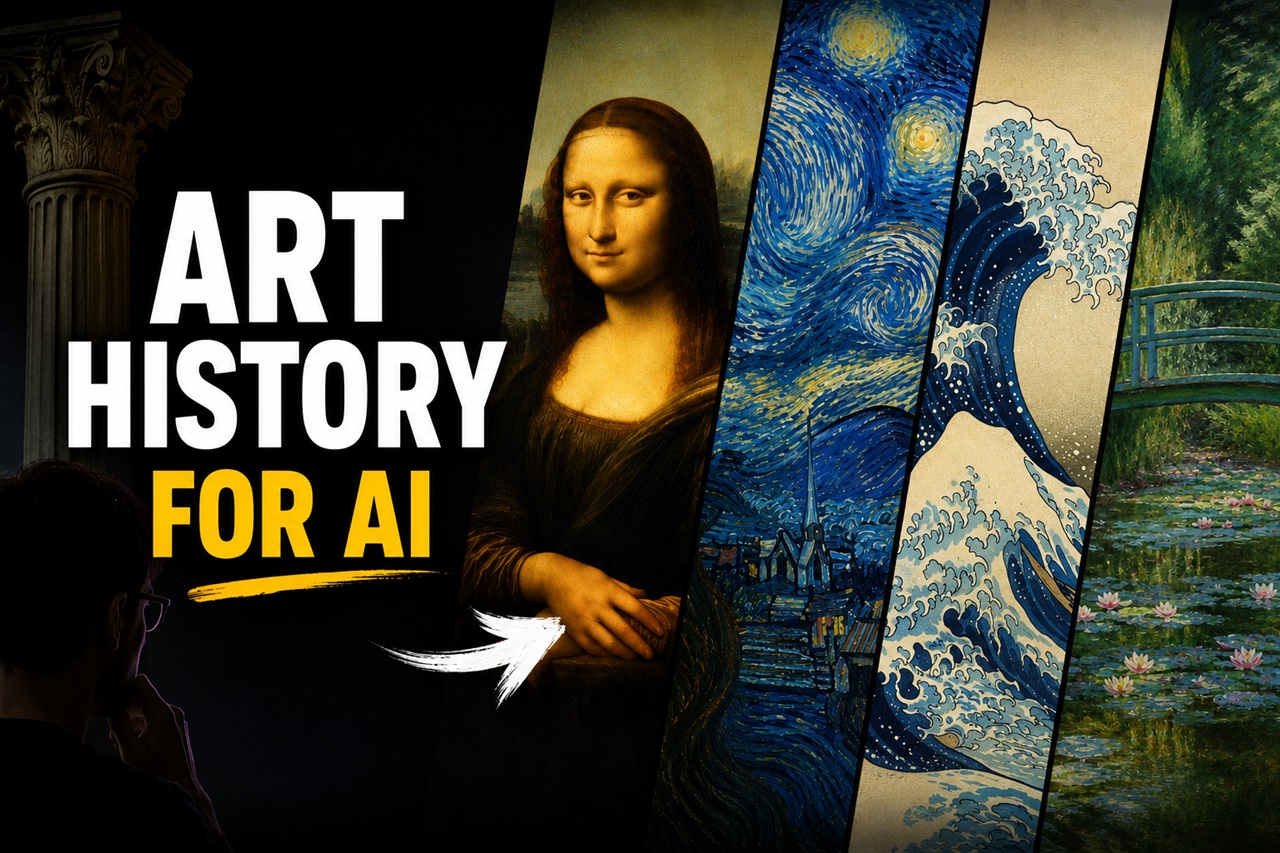
Type "a woman standing in a field" into any image model and you'll get something generic, nice lighting, decent composition, but forgettable vibe. Now add three words: "in the style of Baroque chiaroscuro." Suddenly you've got dramatic shadows, a single shaft of golden light, and a painting that looks like it belongs in a museum instead of a stock photo folder.
That's the entire secret behind this article. AI image models were trained on millions of paintings, illustrations, and photographs, which means centuries of art history are sitting inside the model's weights, waiting for the right keyword to unlock them. You don't need an art degree to use this. You just need to know which eras and movements give you which visual results, and how to combine them without turning your prompt into a confusing mess.
This guide walks you through the art history that actually matters for prompting, no fluff, no jargon, just the styles that reliably change your output and how to use them.
Why Art History Belongs in Your Prompt Toolkit
Most beginners describe subject matter in their prompts - "a castle," "a cat," "a cyberpunk city" but skip style. That's a missed opportunity, because style words often do more visual heavy lifting than subject words.
Think of it this way, your subject tells the model what to draw. Your style reference tells it how to draw it, the color palette, the brushwork, the lighting logic, the mood. Art history gives you a shortcut to all of that in two or three words, because these movements were literally defined by having a consistent, recognizable visual language.
Instead of writing "soft romantic lighting, warm colors, dreamy atmosphere, slightly blurred edges," you can just write "Impressionist" and get most of that for free. The model already knows what Impressionism looks like because it saw thousands of Monet, Renoir, and Degas paintings during training.
How AI Models "Know" Art Styles
Text-to-image models are trained on huge datasets of image-caption pairs scraped from the internet, and a lot of those images are art history: museum archives, digitized paintings, art blogs, Wikipedia entries. Each of those images usually came with a caption or tag mentioning the artist, era, or movement.
Over time, the model learns to associate certain words with certain visual patterns like brushstroke style, color palette, composition rules, subject treatment. So when you type "Rococo," it's not thinking about 18th-century France conceptually instead it's pattern-matching against thousands of pastel-colored, ornate, playful images it saw labeled that way. The more famous and well-documented a style is, the more reliably the model reproduces it.
The Foundation: Naming Your Medium
Before you assign a time period or a famous artist to your prompt, you must define the medium. The medium is the physical material the "artist" used to create the work. If you skip this, the AI will usually default to digital art or a photograph.
Here are powerful historical mediums to add to your Prompt Builder arsenal:
1. Fresco
Pigment painted directly onto wet plaster. Yields muted, earthy colors with a matte texture (e.g., Sistine Chapel).
Prompt Keywords: risograph print, spot color palette, misregistered inks, halftone screen pattern, duotone offset, uncoated coarse paper grain.
2. Risograph
Risograph (or "Riso") is a stencil-based duplicator originally built for office printing, now beloved by indie zine artists for its grainy, slightly imperfect charm.
Prompt Keywords: risograph print, spot color palette, misregistered inks, halftone screen pattern, duotone offset, uncoated coarse paper grain.
3. Impasto Oil Painting
A technique where paint is laid on the canvas in very thick layers, so the brush strokes are clearly visible and three-dimensional.
Prompt Keywords: impasto oil painting, thick palette knife strokes, raised paint texture, visible brushwork, dappled natural light, vibrant unblended oil pigments.
4. Linocut & Woodblock Print
An image carved into wood, inked, and pressed onto paper. Perfect for bold outlines and flat, striking colors.
Prompt Keywords: linocut print, hand-carved relief block, woodcut printing style, visible gouge marks, textured black ink, fibrous mulberry paper.
5. Woodblock Print / Ukiyo-e
Ukiyo-e is the Japanese woodblock printing tradition behind Hokusai's Great Wave and Hiroshige's landscapes. It's defined by bold outlines, flat color fields, and compositions built around negative space.
Key prompt words: ukiyo-e woodblock print, bold black outlines, flat color fields, Edo period, woodgrain texture, stylized waves/clouds, asymmetrical composition, muted natural pigments (indigo, ochre, vermillion)
6. Lithograph
A printing process that creates soft, textured, vintage-looking illustrations, commonly used for old posters and maps.
Prompt Keywords: lithograph, vintage poster art, soft tonal gradients, chalky texture, limited color separations, Art Deco travel poster style
7. Etching & Engraving
This is the world of old scientific illustrations, currency design, and 17th-19th century book plates made by scratching lines into metal plates.
Prompt Keywords: copper plate etching, fine crosshatching, engraved linework, monochrome ink on aged paper, Victorian illustration, intricate line detail, steel engraving texture.
8. Screen Printing / Serigraph
Think concert posters, band merch, and Warhol. Screen printing is about flat, punchy color blocks with crisp edges.
Key prompt words: screen print, serigraph, flat vibrant colors, halftone dots, high contrast, poster art, layered ink registration, bold graphic silhouette
9. Charcoal Sketch
Charcoal is one of humanity’s oldest drawing mediums. Derived from charred wood, charcoal offers an immense tonal range, from soft, dusty grays to rich, velvety blacks.
Prompt Keywords: charcoal sketch, smudged carbon shading, raw gestural charcoal marks, dusty graphite and charcoal texture, toned gray paper, white charcoal highlights.
10. Watercolor Painting
Watercolor relies on translucent layers of water-soluble pigment reacting with wet paper. It is defined by spontaneity, soft color gradients, and organic imperfections.
Prompt Keywords: watercolor painting, translucent color washes, wet-on-wet pigment bleed, spontaneous color blooms, granulating pigment texture, 300gsm cold-press cotton paper tooth, paint splatters.
Time Traveling: Historical Eras & Art Movements
Eras are broad, they span decades or centuries, so they give you a general "flavor" rather than a precise recipe. They're great starting points when you know the mood you want but haven't picked a specific movement yet.
1. Renaissance (14th-17th century)
The High Renaissance and Baroque eras perfected the use of dramatic light and physical oil paint glazes. Understanding classical terminology unlocks immense depth in AI rendering.
Prompt Keywords: Renaissance oil portrait, chiaroscuro lighting, sfumato edge blending, craquelure surface texture, deep varnish glow, glaze oil paint layer on dark linen canvas.
2. Baroque (17th-18th century)
Baroque (17th century) is Renaissance turned up to eleven, more drama, more movement, more shadow. Think Caravaggio, Rembrandt.
Prompt Keywords: Baroque painting, dramatic chiaroscuro, deep shadows, dynamic diagonal composition, rich dark background, tenebrism, theatrical lighting, oil painting texture
3. Rococo (18th century)
Emerging in 18th-century France as a reaction against the rigid grandeur of Baroque art, Rococo is all about playfulness, lighthearted romance, pastel palettes, and theatrical elegance.
Prompt Keywords: Rococo oil painting, pastel color palette, powder blue and blush pink, ornate gilded scrollwork, feathery brushwork, soft whimsical sunlight, fête galante landscape.
4. Romanticism (late 18th-19th century)
Romanticism was an intense artistic movement that placed emotion, mystery, and the overwhelming force of nature over cold industrial logic. Think stormy seas, solitary wanderers, and dramatic twilight horizons.
Prompt Keywords: Romanticism oil painting, sublime nature, tempestuous stormy sky, dramatic sunbeams, atmospheric mist, Caspar David Friedrich aesthetic, emotional depth.
5. Victorian Era (19th century)
The Victorian era sits at the intersection of dark Gothic revival, industrial steam power, and refined decorative arts. From intricate steel-plate book engravings to rich Pre-Raphaelite oil paintings, this era gives AI generations an instant antique authority.
Prompt Keywords: Victorian steel plate engraving, intricate cross-hatching, Gothic ornamental frame, Pre-Raphaelite color palette, deep emerald and ruby tones, vintage botanical illustration.
6. Art Nouveau (Turn of 19th-20th Century)
Popularized at the turn of the 20th century by artists like Alphonse Mucha, Art Nouveau turned nature into flat, decorative art. It is one of the most reliable styles to prompt in AI due to its clear linework and strong graphic structure.
Prompt Keywords: Art Nouveau illustration, Alphonse Mucha style, whiplash linework, organic floral frame, flat decorative shading, muted gold leaf accents, vintage lithograph print.
7. Surrealism (1920s-1940s)
Born out of the psychological shifts of the 1920s and 1930s, Surrealism unlocked the unconscious mind, blending impossible dream logic with crisp, realistic detail.
Prompt Keywords: Surrealist painting, Salvador Dali dreamscape, impossible architecture, vast desolate desert landscape, melting geometric forms, uncanny atmospheric lighting, hyper-detailed dream logic.
8. Pop Art (1950s-1960s)
Exploding in the post-war economic boom, Pop Art embraced mass media, comic books, television, commercial advertising, and industrial screen printing.
Prompt Keywords: Pop Art illustration, Roy Lichtenstein comic book style, heavy black outlines, vibrant Ben-Day dot pattern, flat primary colors, screen print halftone texture.
9. Impressionism & Post-Impressionism (Late 19th Century)
The late 19th century shattered traditional studio painting. Artists broke out of indoor ateliers to paint outdoors (en plein air), capturing fleeting sunlight, atmosphere, and raw human emotion through expressive paint application.
Impressionism Prompt Keywords: Impressionist oil painting, en plein air lighting, dappled sunlight filtering through leaves, broken brushstroke texture, Claude Monet color palette, soft atmospheric haze.
Post-Impressionism Prompt Keywords: Post-Impressionist oil painting, swirling impasto paint texture, expressive directional brushwork, Vincent van Gogh aesthetic, bold emotive color palette, textured canvas grain.
10. Retro Futurism (Mid-20th Century)
Retro Futurism captures how past generations, specifically from the 1920s through the 1980s, imagined the future. The most famous flavor is 1950s Atomic-Age Sci-Fi, characterized by optimism, sleek chrome rockets, rayguns, and bubble-domed cities.
Prompt Keywords: retro-futurism, 1950s atomic age sci-fi, pulp magazine cover art, bubble dome helmet, raygun gothic, technicolor screen print, halftone print texture.
11. Cyberpunk (1980s-Present)
Emerging in the late 1970s and 1980s through literature like William Gibson’s Neuromancer and cinematic masterpieces like Blade Runner and Akira, Cyberpunk defined a gritty vision of the future: "high tech, low life." It fuses hyper-advanced technology cybernetics, artificial intelligence, and holographic displays with decaying urban environments, rainy back alleys, and corporate dystopias.
Prompt Keywords: cyberpunk aesthetic, neon-noir lighting, rain-slicked street reflections, glowing holographic billboards, cybernetic implants, volumetric steam and fog, dense futuristic mega-city, cyan and magenta lighting.
Naming Artists in Prompts, Power and Caveats
This is where prompt engineering gets both more powerful and more delicate. Naming a specific artist ("in the style of Van Gogh," "like a Klimt painting") often produces more consistent, recognizable results than naming a whole movement, because you're pointing the model at one tightly clustered visual signature instead of an entire era's variety.
A few practical notes:
- Long-dead, historically significant artists (Van Gogh, Monet, Klimt, Hokusai, Vermeer) tend to work reliably across most models because their work is extensively documented and public domain.
- Contemporary or living artists are a different situation, many platforms restrict or discourage naming living artists by name, partly for ethical reasons (artists haven't consented to having their signature style replicated at scale) and partly due to platform policy. If you're building prompts for public sharing or commercial use, it's safer to describe the visual traits of a contemporary artist's work rather than naming them directly.
- Blending artist names can create interesting hybrid styles "Van Gogh brushwork with Klimt's gold ornamentation" but too many artist names in one prompt tends to average out into mush rather than blend cleanly. Stick to one or two.
Common Mistakes To Avoid
- Stacking too many styles at once. Five movement names in one prompt usually produces a muddled, indecisive image rather than a rich hybrid. Pick a lead style and one accent, maximum.
- Mismatching subject and era. Asking for "Renaissance style robot" without further guidance can confuse the model, since it has to reconcile two very different training clusters. It can work, but expect to iterate more.
- Forgetting lighting and color words. Movement names imply certain lighting and palette tendencies, but reinforcing them explicitly ("warm golden light," "muted earth tones") makes results more consistent, especially across different models.
- Assuming all models interpret style words identically. A model trained heavily on anime or illustration data will render "Impressionism" differently than one trained mostly on photography. Always run a quick test generation before building an entire prompt pack around one style keyword.
- Ignoring negative prompts. If a style keyword keeps pulling in unwanted elements (like ornate frames when you don't want them), a negative prompt excluding those elements can clean things up fast.
To Summarize
Art history isn't just a subject for museums and textbooks, it's a ready-made vocabulary for controlling how your AI-generated images look and feel. Every era and movement you learn is essentially a shortcut: instead of writing ten descriptive words about lighting, color, and composition, you can often get there with one well-chosen style reference.
Start small. Pick two or three movements from this list, maybe Baroque, Art Nouveau, and Impressionism, and run the same subject through all three. You'll immediately see how differently a "single style word" can reshape an entire image, and you'll start building an instinct for which era fits which mood.
Once you've got a feel for individual styles, the next step is learning to blend them intentionally rather than accidentally, and that's a skill that separates prompt hobbyists from prompt engineers.